Proximal humeral fracture

 Content reviewed by✓Mr Andrew Davies, PhD FRCS (Tr & Orth) and Mr Andrew Sankey, MA (Cantab) FRCS (Tr & Orth)· Reviewed July 2026
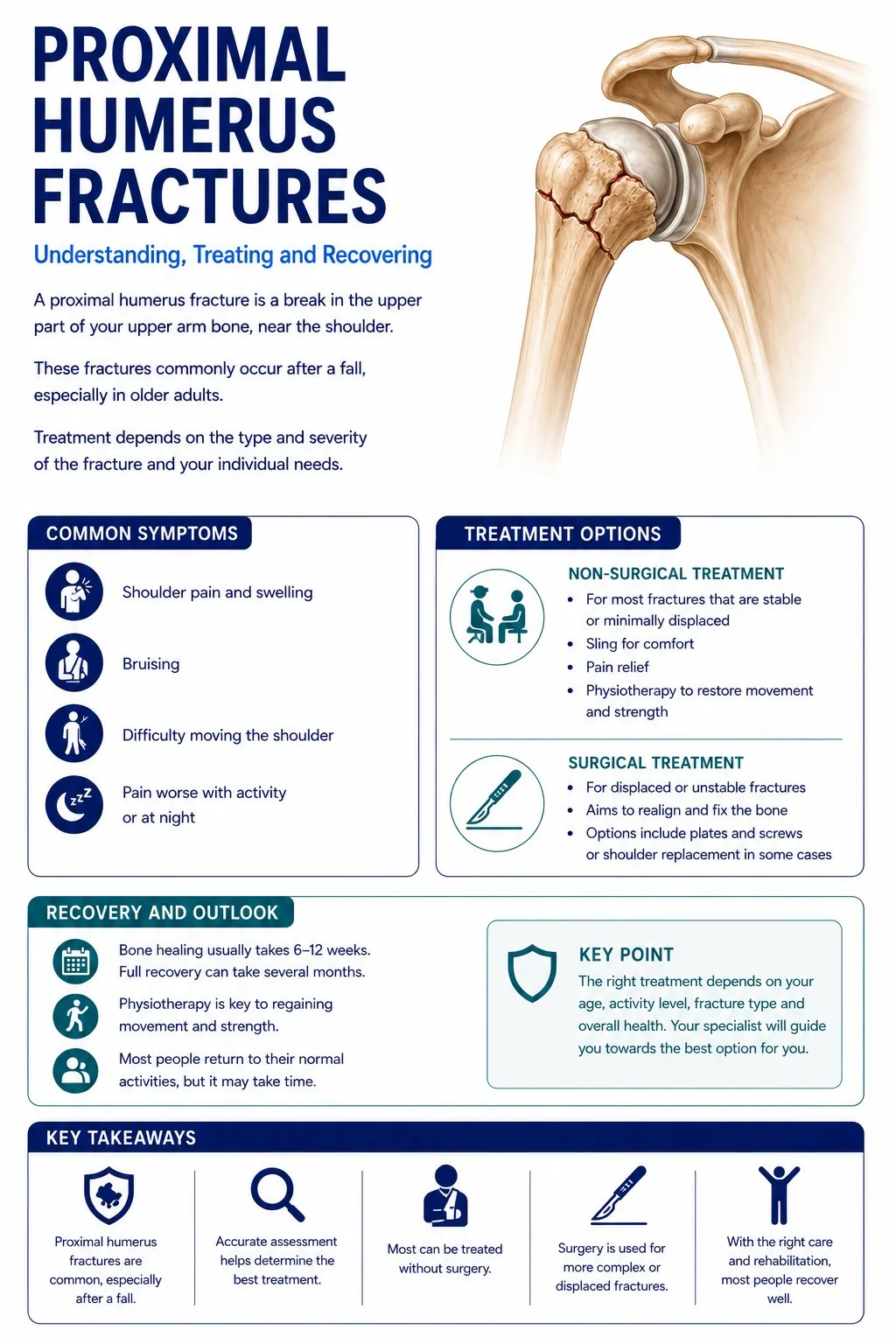
A break at the top of the upper arm bone, close to the shoulder joint. This is one of the most common breaks in older people whose bones have weakened with age. Most can be treated without surgery.
📊 Breaks at the top of the upper arm are one of the three most common fractures in older people with thinning bones (along with hip and wrist fractures). They are more common in women after the menopause. Around half a million people worldwide have this injury each year.

What is a proximal humeral fracture?
This injury is a break at the top of the upper arm bone, the part that forms the ball of the shoulder joint. The bone here is made up of several small pieces (the round head, two bony bumps where tendons attach, and the start of the shaft below). One or more of these pieces can break and shift out of place. The number and position of broken pieces affects how the injury is treated.
Around 8 out of 10 of these breaks are in a good position and heal well without surgery. A large research study showed that in most older patients, surgery does not give better results than treatment in a sling. The shoulder usually gets enough movement back for everyday activities, although it may not be quite the same as it was before.
Any break of this type after a small fall should also prompt a check for osteoporosis, the disease that thins bones. Tablets to strengthen the bones and reduce the risk of further fractures may be recommended, since people who have one of these breaks are at higher risk of breaking another bone in future.
Common causes
- Falls onto the outstretched hand or directly onto the shoulder (the most common cause)
- Road traffic accidents and other high-energy events (in younger patients)
- Tripping at home, especially in older people with weaker bones
Who is at risk? Thinning of the bones with age (osteoporosis) is the most important risk factor, especially in women after the menopause. Anything that increases the risk of falling, such as poor balance, low blood pressure, poor eyesight, or certain medicines, also increases the risk of this injury.
Symptoms
Symptoms vary depending on the severity and duration of the condition. Common symptoms include:
- Sharp pain at the shoulder immediately after the injury
- Significant swelling and extensive bruising at the shoulder, often tracking down the arm
- Inability to lift or move the arm
- The arm is usually held close to the body for support
- Numbness or tingling in the arm, in less common cases where a nerve has been bruised
When to seek help: Go to A&E after a significant shoulder injury, especially if you cannot move the arm or there is heavy bruising. Place the arm in a sling or hold it close to the body until you are seen.
How is it diagnosed?
Your surgeon will take a detailed history and examine the joint. The following investigations may be arranged to confirm the diagnosis:
- Examination of the shoulder, checking the skin, the pulse at the wrist, and the working of the nerves
- X-rays of the shoulder, taken from several angles
- A CT scan with 3D images, in cases where surgery is being considered or where the X-rays do not show the break clearly
- A bone density scan at some point after the injury, to check for osteoporosis
CT scans showing the break in three dimensions help surgeons plan operations and decide whether surgery is needed at all. Plain X-rays alone often underestimate how much the bone has moved.
Treatment pathway
Treatment is tailored to the severity of the condition, your age, activity level, and overall health. Most conditions are treated in a stepwise fashion, starting with the least invasive options.
Sling and physiotherapy
A broad arm sling is worn for around 2 to 4 weeks for comfort. Gentle physiotherapy starts early, usually within 2 weeks, to prevent the shoulder becoming stiff. Most people regain enough movement for everyday tasks. Pain settles over the first few months.
Surgery with a metal plate
For some active, younger patients with badly displaced fractures, a metal plate fixed to the bone with screws may be offered. This holds the bone in a better position and may allow earlier movement, but it carries the usual risks of surgery and may not give a better long-term result for older patients.
Reverse shoulder replacement
When the bone is shattered into many pieces and cannot be rebuilt, especially in older patients, a reverse shoulder replacement may be the best option. This is a special type of shoulder replacement that works even when the rotator cuff tendons are damaged. Most people regain enough movement to live independently.
Recovery
Recovery from these breaks can take many months, especially in older patients. Some shoulder stiffness is very common and often gets better slowly over a year. Pain usually settles well, but many people are left with shoulder movement that is a little less than the other side. This is rarely a problem for daily life.
- Sling: 2-4 weeks
- Physiotherapy starts: Week 2-4
- Bone visibly healing on X-ray: 6-12 weeks
- Most pain settles: 3-6 months
- Maximum recovery: Around 12 months
What results can I expect?
Most people with this injury get back to a good level of function for everyday activities. Studies show that, in older patients, surgery does not usually give a better result than treatment in a sling. Younger and more active patients with badly displaced breaks may benefit from surgery in selected cases.
Top of the upper arm fracture - when is surgery needed?
Common activity questions for this condition. Timelines are approximate, always follow the specific guidance given by your surgeon and physiotherapist.
| Activity | Typical timeline | Notes |
|---|---|---|
| Drive | Months 2–3 | When fracture is healed and arm strength allows safe vehicle control. |
| Sleep in bed | Weeks 1–2 | Propped up initially. Transition to bed when comfortable, usually weeks 1–2. |
| Shower / hair | Week 1 | Remove sling carefully. Support the arm. Refit before putting down. Ask your physio to show you. |
| Return to desk work | Weeks 4–6 | One-handed work possible earlier. Full desk use when arm is more mobile. |
| Manual work | Months 6–12 | Depending on job demands and how well movement has recovered. |
| Driving | Months 2–3 | When fracture is healed, sling is off, and arm is strong enough for emergency stop. |
| Sport | Months 6–12 | Once fracture is healed and movement is restored to functional level. |
Common concerns during recovery, and whether they are expected.
Your questions, answered
Plain-English answers to the things people most often ask, drawn from real patient questions and grounded in published guidance. Tap a question to open it.
About thisWhat is a proximal humerus fracture?
It is a break at the top of the upper-arm bone, near the shoulder. It is common in older adults after a fall and is often linked to thinning of the bone (osteoporosis).
Your choiceDo I need surgery?
The majority are managed without surgery, in a sling, with early guided movement. Surgery, either fixation or sometimes a shoulder replacement, is considered for badly displaced or unstable breaks, particularly in more active patients. Good evidence shows many of these fractures do as well without an operation.
Getting backWhat is recovery like?
Expect a sling for a few weeks, then progressive movement and strengthening. It commonly takes several months to regain comfortable movement, and some aching or stiffness can persist.
StiffnessWhy is my shoulder so stiff?
The shoulder stiffens easily after this injury. Physiotherapy and patience are the main treatment, and most people improve steadily over time.
Pain & sleepHow do I manage pain and sleep?
Pain relief, a sling, and sleeping propped up help early on. Gentle pendulum swings and hand and elbow movements, as advised, help prevent stiffness.
Bone healthShould my bones be checked?
Yes. A fracture from a low fall in an older adult is a good reason to review your bone health and falls risk with your GP, which can reduce the chance of future fractures.
UrgentWhen should I seek urgent help?
Hand numbness or weakness, a cold or pale hand, severe uncontrolled pain, or signs of wound infection after surgery.
WellbeingThe slow shoulder recovery is frustrating.
That is very common with this injury. A realistic timeline and steady physiotherapy support recovery; reach out to your team if progress worries you.
- NHS: Broken arm or wrist
- NHS: Shoulder pain
- British Elbow & Shoulder Society: Early exercises for shoulder problems and sling care
- British Elbow & Shoulder Society: Patient information
These links are to UK clinical guidance and patient information from recognised organisations. This page is for general information and does not replace personalised advice from your own clinical team.
Preparing for surgery?
Read our step-by-step guide - what to expect before, during, and after your procedure.
How is it diagnosed?
- ✓Examination of the shoulder, checking the skin, the pulse at the wrist, and the working of the nerves
- ✓X-rays of the shoulder, taken from several angles
- ✓A CT scan with 3D images, in cases where surgery is being considered or where the X-rays do not show the break clearly
- ✓A bone density scan at some point after the injury, to check for osteoporosis
Recovery milestones
- ●Sling: 2-4 weeks
- ●Physiotherapy starts: Week 2-4
- ●Bone visibly healing on X-ray: 6-12 weeks
- ●Most pain settles: 3-6 months
- ●Maximum recovery: Around 12 months